








Neck Massager Inspection Findings: Closure Guide
A practical framework for documenting neck massager inspection findings, affected lots, corrections, reinspection evidence, and separate shipment-release decisions.
 Meilan Tech 6 min read
“Fixed” is not a complete answer to a neck massager inspection finding. A replacement photograph may show one improved unit without explaining which units were affected, what was changed, or whether the order can be released. For procurement and quality teams, the useful outcome is a traceable decision: an identified requirement, evidence of the problem, a defined action, and a documented reinspection result.
Use the process below for the exact model, configuration, and lot under review. It is a buyer-side reporting framework, not a statement that every Meilan order follows an identical corrective-action procedure.
1. Make each finding reproducible
Give each finding its own identifier. Record the order and lot reference, model, configuration revision, unit identifier, inspection date, and the requirement being checked. Link that requirement to the approved sample, drawing, manual, accessory list, or inspection agreement. “Poor finish” is difficult to investigate; a description of the location and the specific agreed appearance criterion gives both teams a common starting point.
Separate observation from explanation. Record what was seen or measured and the conditions used. A control that does not respond during a check is an observation; a defective circuit board is a proposed cause until supported by investigation. For a functional finding, include the relevant charge state, operating sequence, settings, and the manual version followed. A short video may be more useful than a still image for an intermittent response.
For appearance issues, keep an overall image to locate the area and a close-up to show the detail. Use consistent lighting and retain the original files. Reflections on a metallic-looking surface should not automatically be reported as scratches. Agree how disputed observations will be checked on the physical sample.
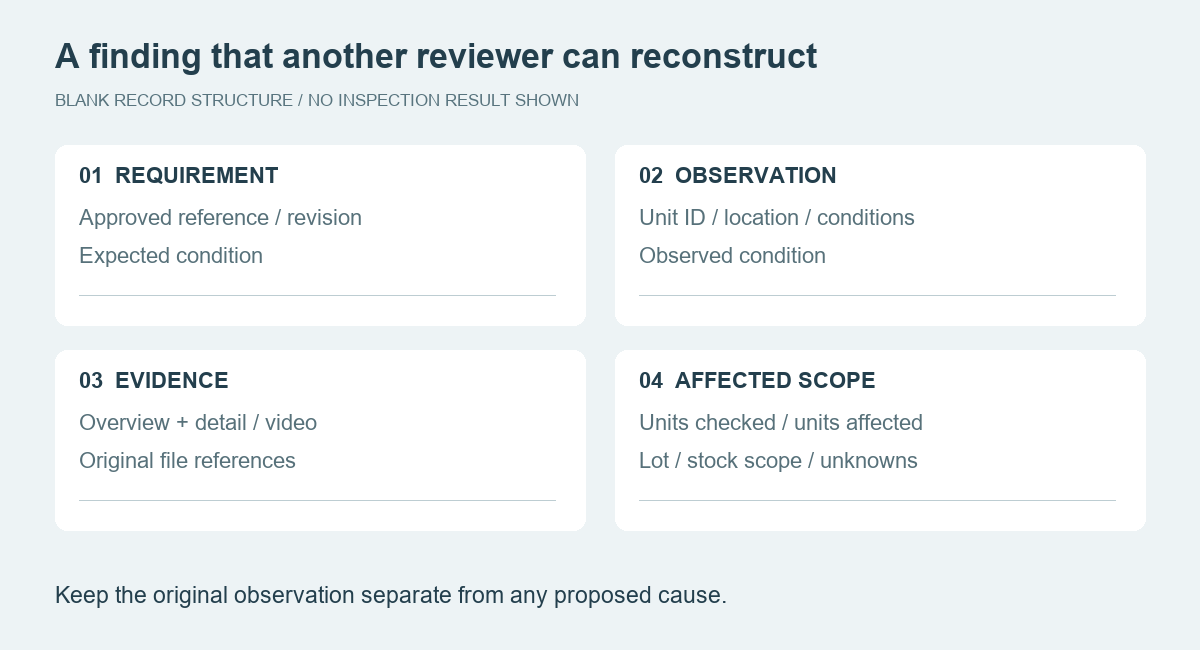
Blank reporting structure for buyer–supplier discussion. No actual defect, test result, or batch decision is shown.
2. Define the affected scope before choosing the remedy
Record how many units were examined and how many showed the finding. Keep those counts tied to the selection method and lot. Three affected units among ten selected units is an observation about that inspection sample; it does not, by itself, establish the defect rate of the whole shipment.
Ask whether the issue may extend to other cartons, production dates, artwork revisions, or accessory configurations. When scope is unknown, record it as unresolved rather than treating the photographed unit as the entire problem. The buyer and supplier should agree what material or stock is held, where it is identified, and who controls its disposition while the finding is reviewed.
The existing neck massager sampling-plan guide explains how to define the lot, selection method, and acceptance rules. Reuse that agreement here instead of inventing a new sample size after a failure appears.
Classify the finding against the agreed inspection criteria. Do not let a generic “minor” label settle a question involving electrical behavior, contact surfaces, or use instructions. Where a potential safety concern arises, route it to the responsible technical or compliance reviewer and keep release unresolved until the applicable decision is documented.
3. Distinguish correction from prevention
A correction addresses the affected product: for example, replacing an incorrect instruction insert or reworking an approved printing issue. A corrective action addresses a supported cause so the same issue is less likely to recur. These may require different owners and different evidence.
If an incorrect insert is found, replacing it may correct the checked units. It does not establish that every affected carton has been found or explain how obsolete inserts will be prevented from entering later packing runs. Ask for the stock scope, the replacement record, the investigation outcome, and the proposed control for future work. This is a hypothetical example, not a reported Meilan incident.
For each agreed action, record an owner, a due date, the affected scope, and the evidence required for completion. If the cause is still under investigation, say so. An unverified cause followed by a generic promise to “strengthen training” gives the buyer little basis for judging whether the recurrence risk has changed.
Proportion the response to the issue. A single straightforward packing correction may need a concise action record; a repeated or potentially consequential functional problem may require deeper investigation and evidence of effectiveness. Agree that depth rather than requesting an elaborate report for every observation.
4. Agree on reinspection before accepting the action
Define what will be checked again, which units will be available, who will select them, and which acceptance criteria apply. Identify whether the check covers the original affected units, a reworked lot, replacement units, or a subsequent production lot. These are different populations and should not share an ambiguous “retest passed” statement.
A replacement sample can help assess the proposed correction. It cannot establish that the whole held lot was corrected. Likewise, checking one reworked unit does not demonstrate the effectiveness of a process change across future production. Match the evidence to the claim you intend to close.
If a remedy changes a component, control behavior, artwork, or packaging specification, review which approvals need updating. The product and packaging sample-approval guide helps separate these approval boundaries. A corrected box does not automatically reapprove the device, and a revised device does not automatically approve its instructions.
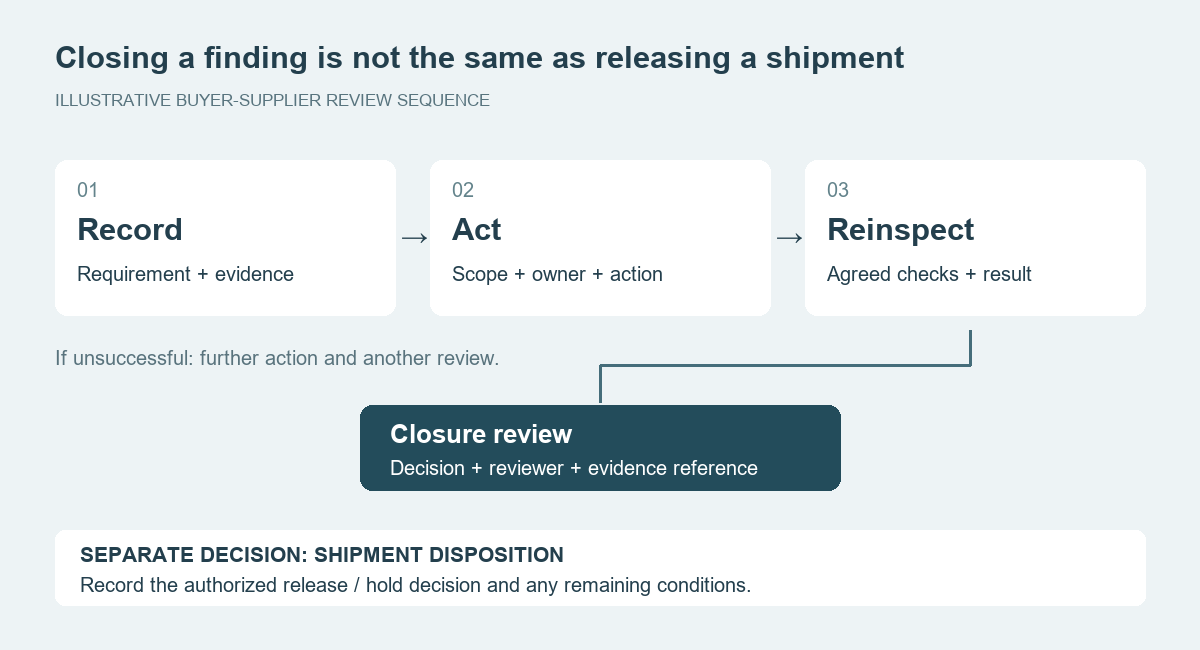
Suggested review sequence. Reinspection failure returns the finding for further action; shipment release remains a separate authorized decision.
5. Close the finding with a recorded decision
Use clear statuses such as Open, Action Agreed, Awaiting Reinspection, and Closed. Keep shipment disposition in a separate field, with its own decision owner and date. A finding may be resolved while other order requirements remain open.
Close the record only when the agreed closure evidence has been reviewed by the authorized person. Retain the original finding, action history, reinspection method and results, and the approval reference. If a buyer accepts a deviation, record the exact scope, quantity, conditions, and authorization. Acceptance of a deviation is not evidence that the original requirement was met, and should not silently become the standard for a reorder.
For actions intended to prevent recurrence, agree when effectiveness will be reviewed. If that evidence will come from a later lot, keep the follow-up visible even if the immediate product correction has been accepted. Separate dates make it clear which decision has actually been made.
A blank log your team can adapt
Use one row per finding and linked files for detailed evidence. The fields below are a starting point; agree the actual acceptance rules and approval authority for your order.
| Record group | Fields to complete |
|---|---|
| Identity | Finding ID; order/lot; model/configuration; unit IDs; date |
| Requirement and observation | Approved reference/version; expected condition; observed condition; inspection conditions |
| Evidence and scope | Original photo/video/report links; units checked/affected; affected stock; scope still to confirm |
| Action | Containment; correction; supported cause or investigation status; corrective action; owner; due date |
| Reinspection | Population; selection method; checks/criteria; date; result; evidence |
| Decisions | Closure reviewer/date; deviation authorization if any; shipment disposition/approver; effectiveness follow-up |
Before a neck massager order moves forward, ask one practical question: can someone outside the original email exchange reconstruct why the finding was closed and who authorized release? If the answer depends on an unlabelled photograph or a chat message saying “OK,” the record needs another pass.
Contact Meilan with the model, order reference, approved requirement, and finding evidence to discuss the appropriate investigation and follow-up. Agree on the response and review process for the specific configuration before relying on a general pass/fail statement.

