


F12 Neck Massager: Mapping Contact Points During Sample Review
When an F12 sample feels uneven, “the fit is uncomfortable” gives a supplier little to investigate. A useful review identifies which contact location loses contact, in what position, and whether repositioning resolves it. That record helps a brand buyer decide whether to approve the configuration, improve the instructions, or request another sample.
A contact map is a simple record of locations and observations. It does not measure electrical output, temperature, pressure, or treatment effectiveness. Its value is making a subjective sample discussion specific enough to repeat.
1. Identify the Head Assembly Before Naming Contact Points
The Meilan F12 product page lists interchangeable magnetic 2-head, 4-head, and 6-head configurations, with TENS pulse, vibration, and heating. Start with the assembly actually supplied. Record the sample ID, head configuration, manual revision, and any supplier version reference.
The device also has side contact elements visible in the product materials. Ask whether a quoted head count describes the removable rear assembly or all contact elements on the device. Mixing those two counts makes photographs, specifications, and review notes difficult to reconcile. Also obtain a function map for each assembly: the page's overall function list should not be treated as confirmation that every attachment delivers every function identically.
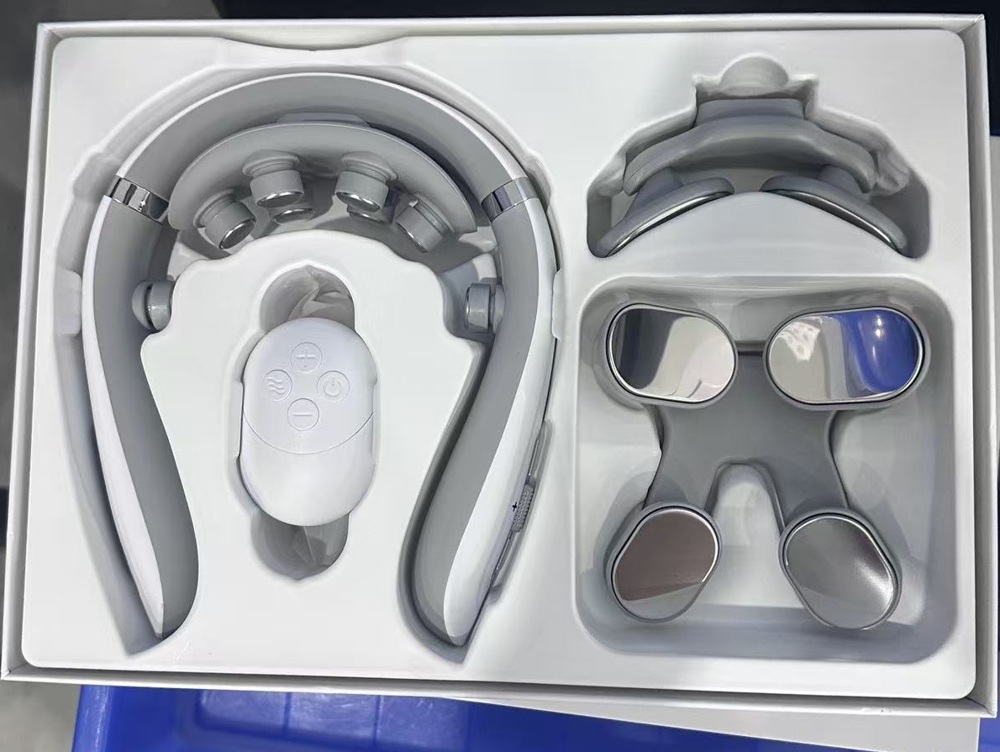
The supplied F12 kit photo shows different head assemblies. Use it to identify the review configuration; confirm the contents of the quoted kit separately.
Take an inward-facing photograph of your sample with the power off. Assign each visible contact location an ID on a copy of the photo. State the viewing direction, and distinguish the wearer's left and right. Keep the same IDs throughout the review; use a separate reference photo when the assembly changes. These IDs are your team's recording convention, not Meilan part numbers.
2. Establish a Repeatable Fit Check
Choose reviewers who reflect the intended audience and use anonymous participant IDs. A single comfortable fit is useful feedback, but it cannot establish suitability across different neck shapes. A small internal review can identify issues to investigate; it cannot justify a population-wide fit claim.
First check placement with the power off. Follow the instructions supplied for that exact sample when preparing the skin and positioning the device. Keep hair, collars, and other obstructions clear as instructed. Record the starting posture and any adjustment the wearer needs to make.
Use the same observation sequence for each assembly: initial placement, a settled neutral posture, and any small posture change permitted by the manual and relevant to the intended use. Do not add stretching or vigorous movement simply to create a harder test. Note whether normal placement is sufficient or whether the wearer must keep holding the device to maintain contact.
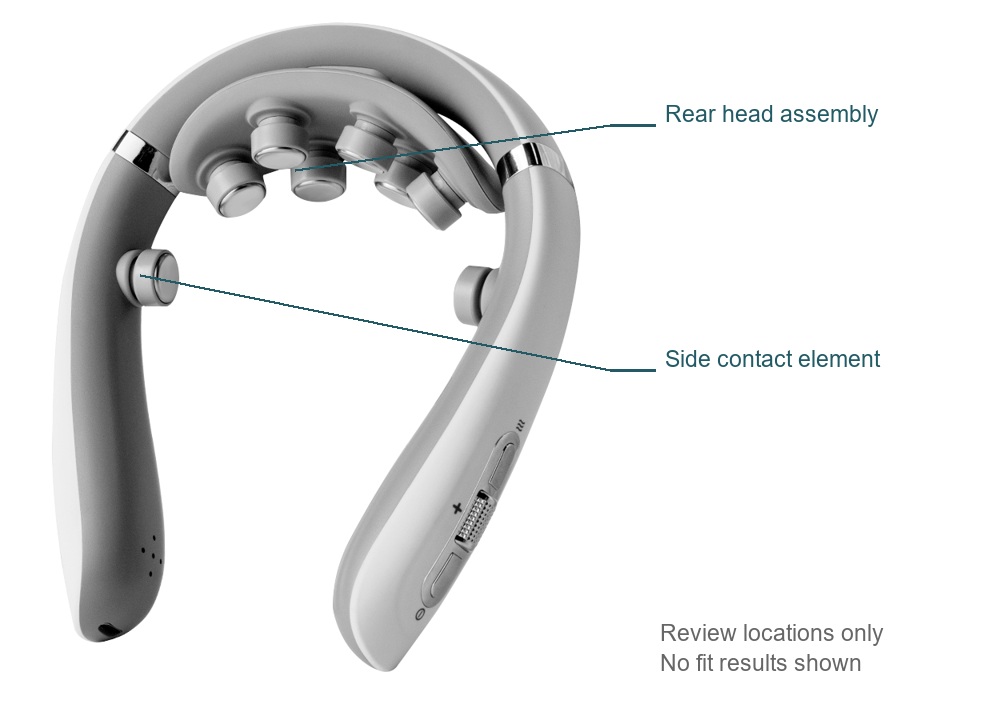
The callouts identify areas to document on the actual sample. This supplier product visual contains no measured fit results.
A broader assembly may offer more contact locations, but each still needs to meet the wearer appropriately. An extra location that repeatedly lifts away adds a review question rather than evidence of better coverage. Record the actual pattern before preferring a higher head count.
3. Record Contact, Pressure Feel, and Sensation Separately
For each numbered location, distinguish visible observations from what the wearer reports. A photograph can show an accessible gap or a tilted assembly; it cannot establish contact at a hidden surface. Mark that location “not observable” instead of assuming it is fully seated.
Use plain descriptions: “visible gap at the lower edge,” “wearer reports local pressure,” or “contact changes after repositioning.” Reserve “intermittent” for a change you actually observe during the recorded sequence. Do not describe subjective pressure as a measured force or warmth as a measured temperature.
| Record field | What to enter | Why it helps |
|---|---|---|
| Sample and assembly | Sample ID, version, fitted head | Keeps observations tied to one configuration |
| Contact location | ID matched to the reference photo | Identifies the area to investigate |
| Fit observation | Contact visible, gap, change, or not observable | Separates evidence from assumptions |
| Wearer feedback | Local pressure or discomfort, in their words | Preserves the subjective response |
| Conditions and adjustment | Posture, settings if powered, repositioning | Makes a follow-up review repeatable |
| Follow-up | Supplier question and retest outcome | Connects the note to an approval decision |
If powered evaluation is appropriate under the sample's instructions, record mode, intensity, heat status, and elapsed time. Follow the manual's restrictions and stop if discomfort occurs. Compare physical placement before changing settings: increasing intensity cannot explain why a head visibly loses contact. Likewise, a stronger reported sensation does not prove a larger contact area.
Keep this record within its scope. Electrical performance, heat distribution, and safety require their own suitable evaluation methods; the contact worksheet does not replace them.
4. Turn an Uneven Fit Into a Supplier Question
An actionable note might read: “On sample A with assembly B, location R3 showed a visible edge gap in the recorded seated posture. After repositioning according to the supplied instructions, the gap remained.” This is an illustrative reporting format, not a Meilan test result.
Attach the labeled reference photo and the relevant observation image. Ask the supplier to confirm the intended assembly orientation and placement, then reproduce the observation on the same version. That is more useful than immediately requesting a stronger pulse or a larger head.
Look for patterns before deciding on a change. If correct placement consistently resolves an issue, clearer instructions may be the next step. If several intended reviewers show the same unresolved gap, discuss another assembly or a fit requirement. If one sample differs from an otherwise comparable sample, investigate the physical difference before changing the whole product brief.
If the proposed solution changes geometry, contact materials, or electronics, use Meilan's OEM/ODM project route to discuss the exact scope. Record what needs to change and what must be reviewed again; do not assume a suggested modification is already available.
5. Approve a Configuration With Traceable Limits
Before reviewing samples, agree on what findings would block approval for your intended use. There is no universal contact score in this worksheet. Your criteria should distinguish unresolved placement problems, unacceptable wearer discomfort, and questions requiring technical evaluation.
Retain the selected assembly, labeled photo, observation sheet, supplier responses, and approved reference sample together. Record unresolved items with an owner and a follow-up date. If a new version arrives, repeat the affected checks rather than transferring approval from a similar-looking sample.
The resulting decision should name the configuration and review scope. “Approved for the reviewed brief with the recorded assembly and instructions” is more useful than “fits everyone.”
Contact Meilan with your F12 sample ID, target audience, selected head assembly, and labeled contact observations. Request the matching specification and operating instructions so the next sample discussion starts from the same evidence.

