

Technical guide
Li-Ion Capacity: mAh, Watt-Hours and Runtime
Battery capacity in mAh describes charge, while watt-hours account for voltage.
More context
F10 publishes 3.7 V and 400 mAh, giving a nominal 1.48 Wh by multiplication. That calculation is not measured runtime: heater demand, motor load, control settings and usable battery energy determine how long the complete product operates.
 Meilan F10 Smart Electric Neck Massager View model details
Products and selection
Compare relevant models

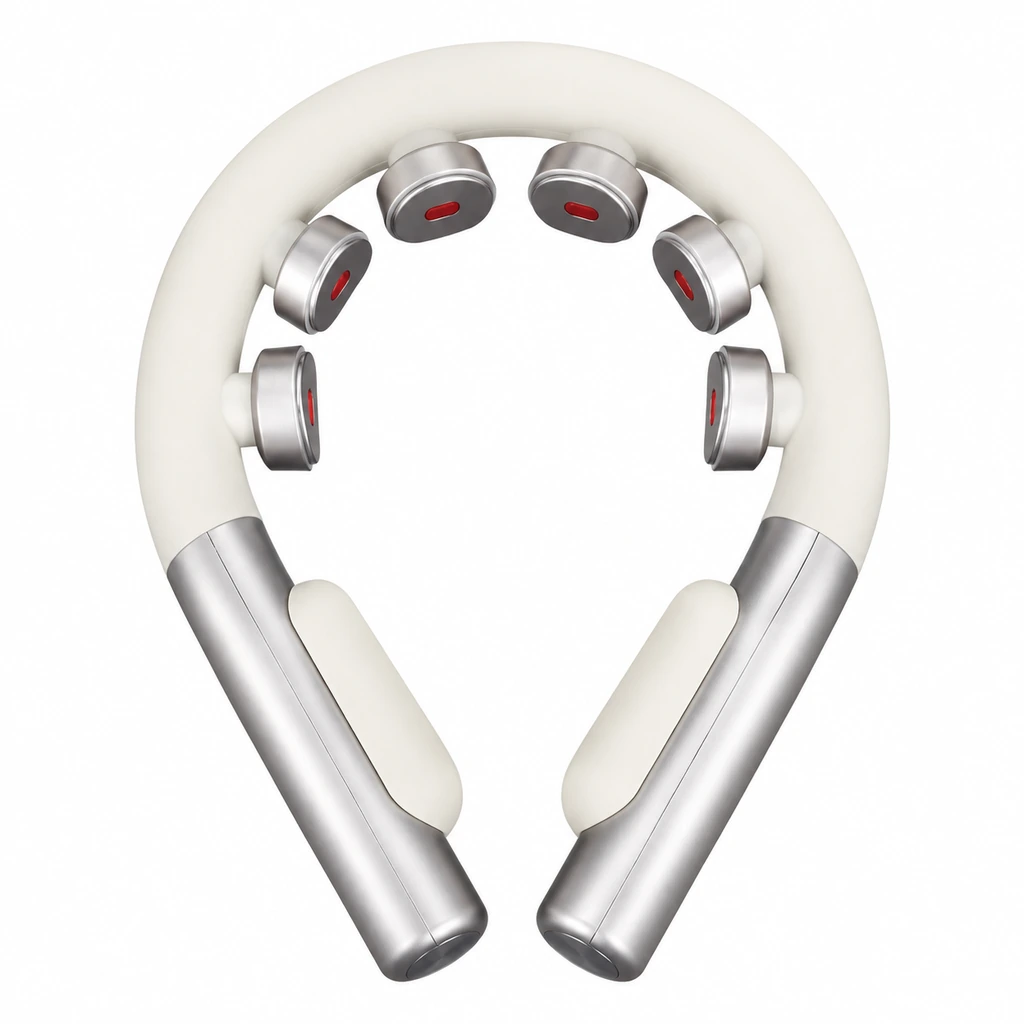
Buyer facts
Facts to compare
| Parameter | Value or status | Evidence scope |
|---|---|---|
| F10 battery rating | 3.7 V; 400 mAh | Published in same field |
| F10 nominal-energy calculation | 1.48 Wh | 3.7 × 0.4 Ah; calculated, not measured |
| F11 runtime | About 105 minutes | 400 mAh; stated conditions not detailed |
| F100 runtime | Up to 110 minutes | 1000 mAh; not a shared-condition comparison |
Meilan manufacturing profile
Meilan at a glance
Purchasing considerations
Before you order
What the term means
- Li-Ion Capacity
mAh measures electric charge capacity. Nominal energy in Wh equals nominal voltage multiplied by capacity in Ah; runtime also depends on load, conversion losses and usable energy.
Published implementation and related model scope
- Catalog examples
F10 supports the voltage-and-capacity calculation. F11 and F100 illustrate why stated runtime is a separate complete-product value.
Buyer guide
Selection guide
How can mAh be converted into nominal watt-hours?
Nominal watt-hours can be calculated when both voltage and charge capacity refer to the same battery. The relationship is Wh equals volts multiplied by ampere-hours, and one thousand mAh equals one Ah. F10 publishes 3.7 V and 400 mAh in its battery-capacity field. Converting 400 mAh to 0.4 Ah gives 3.7 multiplied by 0.4, or a nominal 1.48 Wh. This is an arithmetic energy estimate from the published ratings, not a measured delivered-energy result. The distinction matters when comparing products at different voltages because identical mAh values can represent different nominal energy.
Why do capacity, charging time and runtime tell different stories?
Capacity, charging time and runtime describe different stages of the energy system. Capacity concerns stored charge, charging time concerns replenishment under stated conditions, and runtime concerns energy consumption during operation. Heating, vibration and electrical pulse functions can impose different loads, while conversion losses and low-battery cutoffs affect usable energy. F11 publishes a 400 mAh battery and about 105 minutes of working time; F100 publishes 1000 mAh and up to 110 minutes. These catalog estimates do not establish identical test conditions, so their ratio cannot be treated as a battery-efficiency ranking. A larger battery can support a higher load rather than a proportionally longer session.
Purchasing FAQ
Common buying questions
Is mAh an energy unit?
No. It measures charge; Wh incorporates voltage.
What is F10's calculated nominal energy?
It is 1.48 Wh from 3.7 V multiplied by 0.4 Ah.
Can USB input voltage replace an unknown battery voltage?
No. The charging input and battery rating are different quantities.
Does a fifteen-minute timer mean only fifteen minutes per charge?
No. A session timer and total runtime are different.
Do F11 and F100 prove a controlled efficiency comparison?
No. Their runtime entries do not establish identical measurement conditions.
Talk to Meilan
Discuss your sourcing brief
Share your target market, model, quantity and branding needs. We will review the right configuration with you.
