


Eye Massager Strap Fit Review: What Buyers Should Inspect

Quick answer: Strap fit cannot be judged from a product photo or one try-on. Buyers should record adjustment from loose to snug, inspect the bridge and eye-area contact surfaces, then run the same mode and timing with several face shapes. Keep photos, record IDs and a Pass, Revise or Unverified result for each sample.
Why strap fit needs its own review
An eye massager’s wear experience depends on strap length, adjustment method, contact materials and the device while it is running. For a personal-care brand, a record supports an accurate product description. For a gift buyer, it reduces surprises during first use. Do not turn one tester’s comfort into a universal claim.
Record the full adjustment range first
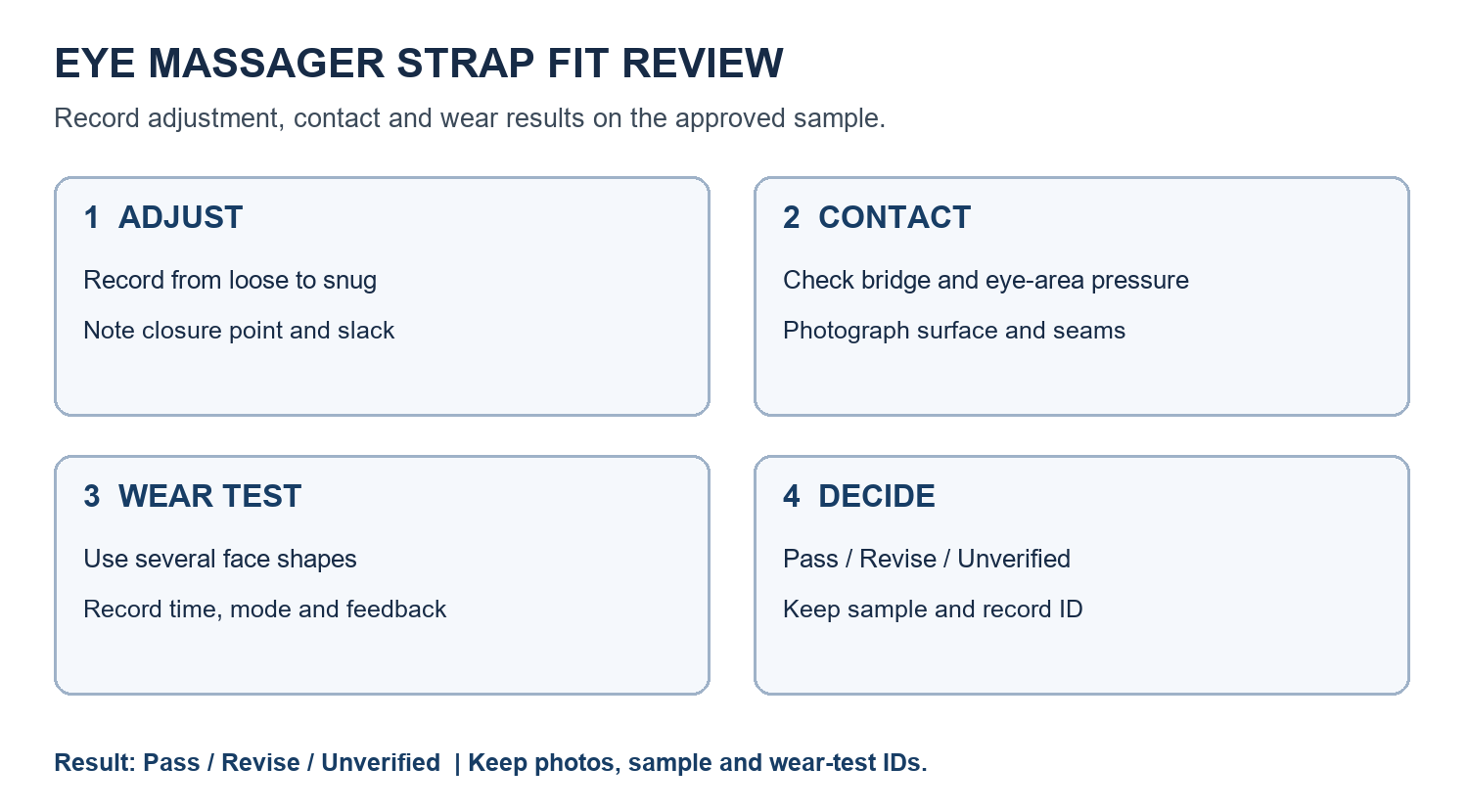
With the device off, start with the strap at its loosest setting and tighten it step by step. Record the closure position, remaining slack, whether adjustment needs two hands and whether the strap slips during operation. Photograph front, side and rear views with the sample ID visible.
Inspect the contact surface, not only the silhouette
Check the nose bridge, eye-area edges, lining, seams and any part that touches skin. Record folds, hard edges, pressure points and blocked vision. A product photo cannot prove material composition, cleanability or long-term comfort.
Create a repeatable wear-test record
Use at least three testers with different face shapes or wearing habits. Record head size or strap position, wear time, mode, settings, readjustments, slipping and the tester’s own words. Separate operation feedback from fit feedback.
Compare Y-series samples under the same conditions
If evaluating Y5, Y8 or Y9, match each sample to its specification sheet and operating demonstration. Use one wear-test form and compare adjustment, contact surface and readjustments. Mark items without matching photos and records Unverified.
Turn the record into a purchase decision
Pass: adjustment is clear, no obvious contact anomaly appears and the record is complete.
Revise: strap, lining, seam or instructions need a change.
Unverified: exact configuration, photos, demonstration or record is missing.
Strap-fit review diagram
Purchase decision checklist
| Check | Pass when | Evidence |
|---|---|---|
| Adjustment | Position and slack recorded; no slip | Photos and sample ID |
| Contact | Bridge, lining, seams and pressure documented | Close-ups and material note |
| Wear test | Same mode and timing with several testers | Tester sheet and quotes |
| Version match | Sample, specification and demo match | Approved record |
| Claim control | Pass/Revise/Unverified assigned | Decision log |
Before final approval, request the matching Y-series specification, operating demonstration and strap or contact-surface photos and records.
Frequently asked questions
Can one tester prove the strap fits?
No. One tester can reveal a problem, but cannot establish a universal fit. Use several testers and report the conditions.
What should a strap photo show?
Show the sample ID, closure position, remaining slack and the strap where it meets the body. Add close-ups of seams and contact areas.
Should testers use the same mode?
Yes. Keep mode, timing and major settings consistent so fit feedback can be compared.
How should a buyer describe comfort?
Describe the tested conditions and tester feedback. Avoid “fits everyone,” “all-day comfort” or similar unsupported claims.
What evidence should be requested for Y-series sourcing?
Request the matching specification, operating demonstration, strap/contact photos and dated wear-test records.
Compare the exact Y-series configuration
Review MeilanTech’s eye massager collection. Compare Y8, Y9 and Y5 product pages, then send the SKU, market, quantity and evidence request through the contact page.

